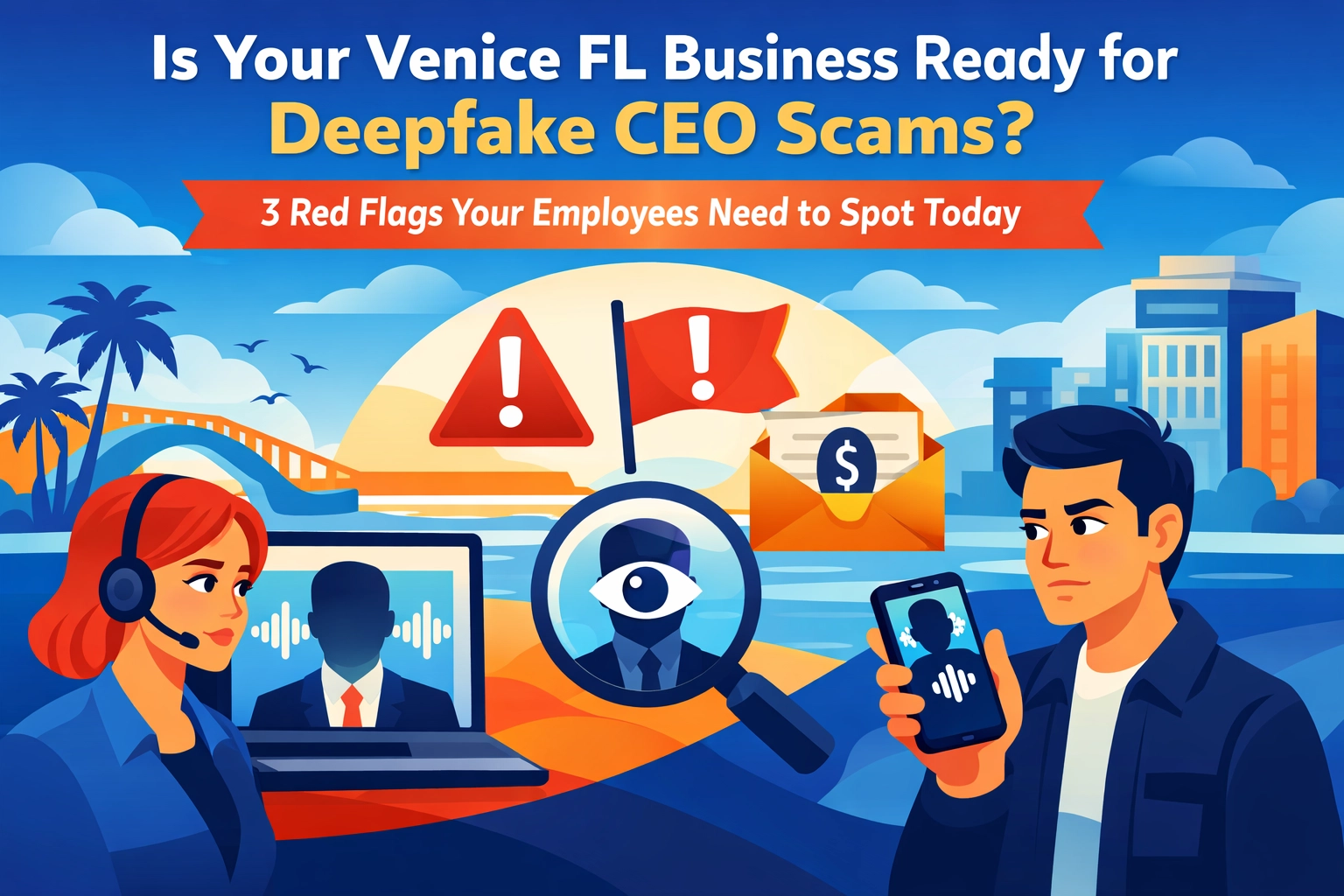

Picture this: Your accounts payable manager gets a video call from your CEO asking them to wire $50,000 for an urgent acquisition deal. The voice sounds right. The face looks exactly like your boss. There's just one problem: your CEO is actually on vacation in the Keys, and that "video call" was created by AI in about 10 minutes.
Welcome to 2026, where deepfake technology isn't just Hollywood special effects anymore. It's the newest weapon in a scammer's toolkit, and it's targeting businesses right here in Venice, North Port, and Englewood.
What Exactly Are Deepfake CEO Scams?
Let's break this down in plain English. Deepfake scams use artificial intelligence to create incredibly realistic fake videos or audio recordings of executives, CEOs, or other authority figures. These aren't the obviously fake robocalls you're used to: we're talking about technology that can clone someone's voice from just a few seconds of audio and create video that looks real enough to fool your most trusted employees.
Scammers scrape publicly available content: think YouTube videos, LinkedIn clips, earnings calls, or even your company's promotional materials: to train AI models. Within hours, they can create a convincing impersonation that sounds like your CEO, uses the same mannerisms, and even appears to be calling from familiar surroundings.
The goal? Pressure employees into transferring money, sharing sensitive data, or bypassing normal security protocols. And truthfully, it's working. According to recent data, businesses are losing millions to these sophisticated attacks because employees simply don't know what to look for.
Red Flag #1: Sudden Urgency and Unusual Pressure
Here's the thing about legitimate business requests: they follow procedures. Your actual CEO knows there's an approval process for wire transfers. Your CFO understands that financial transactions require documentation. But scammers? They're banking on creating panic.
Watch for these urgent pressure tactics:
- Time pressure: "We need this wire transfer completed in the next 30 minutes or we'll lose the deal"
- Secrecy demands: "Don't mention this to anyone: it's confidential until the acquisition closes"
- Bypassing protocols: "Skip the usual approval process this one time: I'll handle the paperwork later"
- Unusual timing: Requests coming late at night, on weekends, or during known vacation periods
I've seen this play out with local Venice businesses. One company nearly lost $35,000 because an "executive" called their bookkeeper on a Friday afternoon, creating urgency around a supposed vendor payment that "couldn't wait until Monday." The bookkeeper's gut said something was off, and thankfully, they verified before transferring the funds.
The reality is that legitimate business emergencies are rare, and when they do happen, they still follow verification procedures. If your supposed boss is telling you to break standard protocols, that's your first massive red flag.
Red Flag #2: Communication Channel Anomalies
Scammers love to catch people off-guard by using unexpected communication methods. Your CEO normally emails financial requests? Suddenly they're calling from an unknown number. Your CFO always schedules video meetings through your company calendar? Now they're sending a random Zoom link via text message.

Here's what should immediately trigger suspicion:
- Channel switching: Contact coming through unusual platforms (WhatsApp instead of corporate email, phone call instead of Teams)
- New contact information: Requests to use different phone numbers, email addresses, or payment accounts
- Communication isolation: Instructions to keep the conversation private or not verify with other team members
- Behavioral inconsistencies: Language, tone, or communication style that doesn't match the person's typical patterns
I always tell clients in North Port and Englewood: your brain is your best security tool. If something feels "off" about how a request is being made, trust that instinct. Legitimate executives won't be offended if you verify their identity: in fact, they'll appreciate your caution.
One practical tip: establish a verification code word or phrase with key executives that can be used to confirm identity during unusual requests. Make it something personal that couldn't be easily discovered online.
Red Flag #3: Subtle Technical Irregularities
Now, deepfake technology is getting scary good, but it's not perfect. If you're actually on a call or video chat, there are still telltale signs that what you're seeing or hearing isn't real.
Audio red flags include:
- Slight delays or unnatural pauses in conversation
- Audio quality that doesn't match the video quality
- Background noise that seems inconsistent or artificial
- Responses that seem slightly "off" or don't fully address your specific questions
Video warning signs:
- Lighting that doesn't quite match natural patterns
- Lip-sync issues, even minor ones
- Unnatural eye movements or blinking patterns
- Edges around the face that seem slightly blurred or inconsistent
- Frozen or oddly static backgrounds
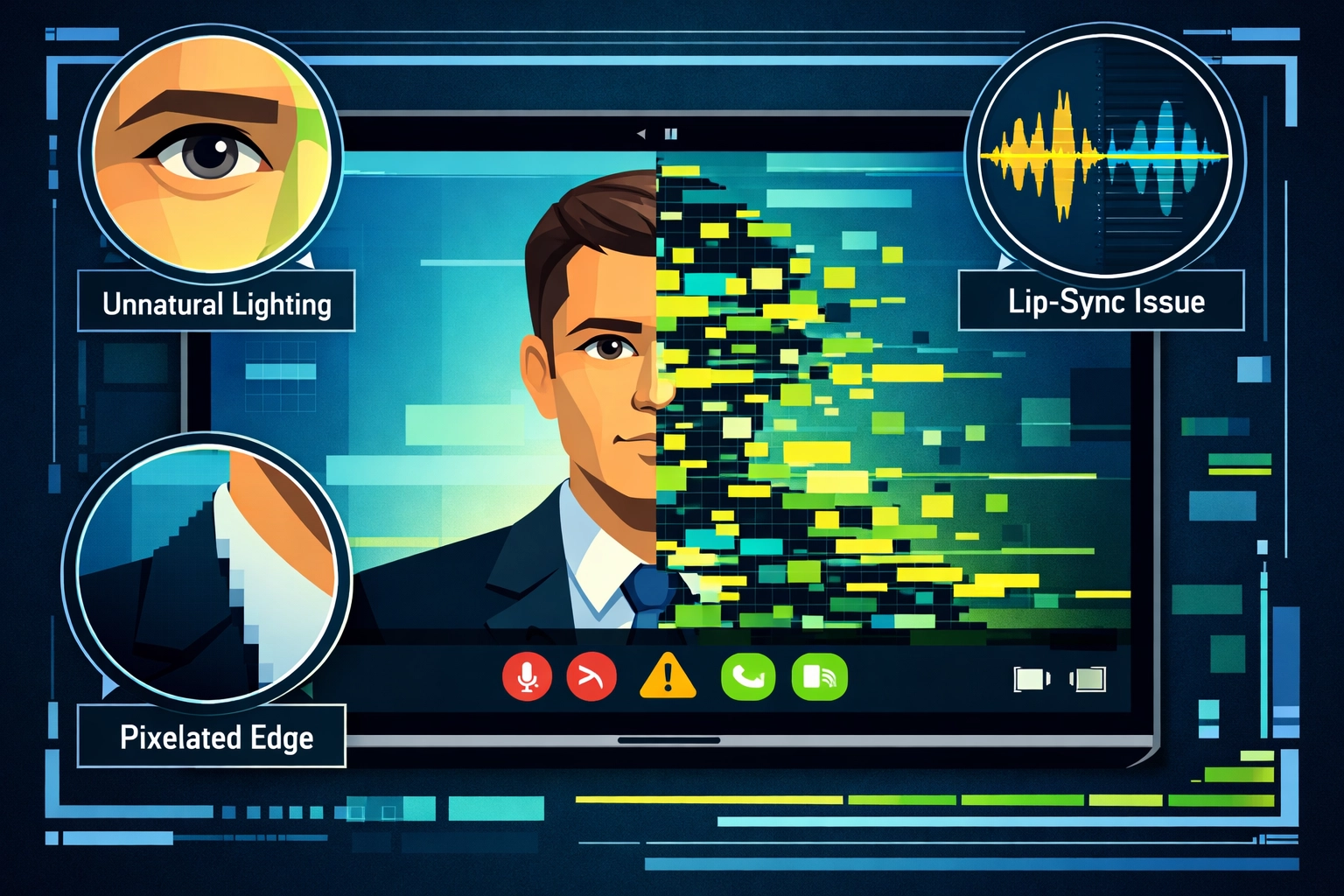
However: and this is important: don't rely solely on trying to spot technical flaws. The technology improves daily, and honestly, most people won't catch these subtle issues in real-time during a high-pressure situation. That's why verification protocols are so critical.
What Venice FL Businesses Need to Do Right Now
Look, I'm not trying to scare you. But as someone who's been working with local businesses in the Venice area for years, I can tell you that preparation is everything. Here's what you need to implement today:
Establish Clear Verification Protocols: Create a simple system where any financial request over a certain threshold requires secondary verification through a different channel. If someone calls requesting a wire transfer, require an email confirmation to a known address. If someone emails, require a phone call to a number you have on file: not one provided in the suspicious message.
Train Your Team Regularly: Your employees are your front line of defense. Conduct regular training sessions about deepfake scams, and make it clear that verifying requests isn't questioning authority: it's protecting the company. Run simulation drills where you test their response to suspicious requests.
Implement Technical Safeguards: Use multi-factor authentication for financial systems, set up transaction alerts for unusual payment patterns, and consider implementing AI detection tools that can flag potential deepfake content.
Create a Security Culture: Make it safe for employees to question unusual requests without fear of repercussions. The bookkeeper who "bothers" the CEO with a verification call might just save your company thousands of dollars.
The Bottom Line for Local Business Owners
Unfortunately, deepfake scams aren't going away: they're only getting more sophisticated. But here's the good news: with proper awareness and simple verification procedures, they're also preventable.
If you're running a business in Venice, North Port, or Englewood, you can't afford to ignore this threat. The scammers are counting on your employees not knowing what to look for, not having verification protocols, and feeling too intimidated to question what appears to be a directive from leadership.
At Computers Done Right, we're helping local businesses implement comprehensive security training and verification systems specifically designed to combat these AI-powered threats. Our approach isn't about installing expensive software: it's about creating practical, human-centered defense systems that your team will actually use.
Don't Wait Until It's Too Late
The best time to prepare for a deepfake scam was yesterday. The second-best time is right now. We're offering FREE security assessments for Venice-area businesses to identify vulnerabilities in your current financial approval processes and employee training.
Want to protect your business before scammers target your team? Visit our cyber security resources or call us directly. We'll help you implement verification protocols that stop deepfake scams in their tracks: without disrupting your daily operations.
Because in 2026, the question isn't whether scammers will target your business. It's whether your team will be ready when they do.